




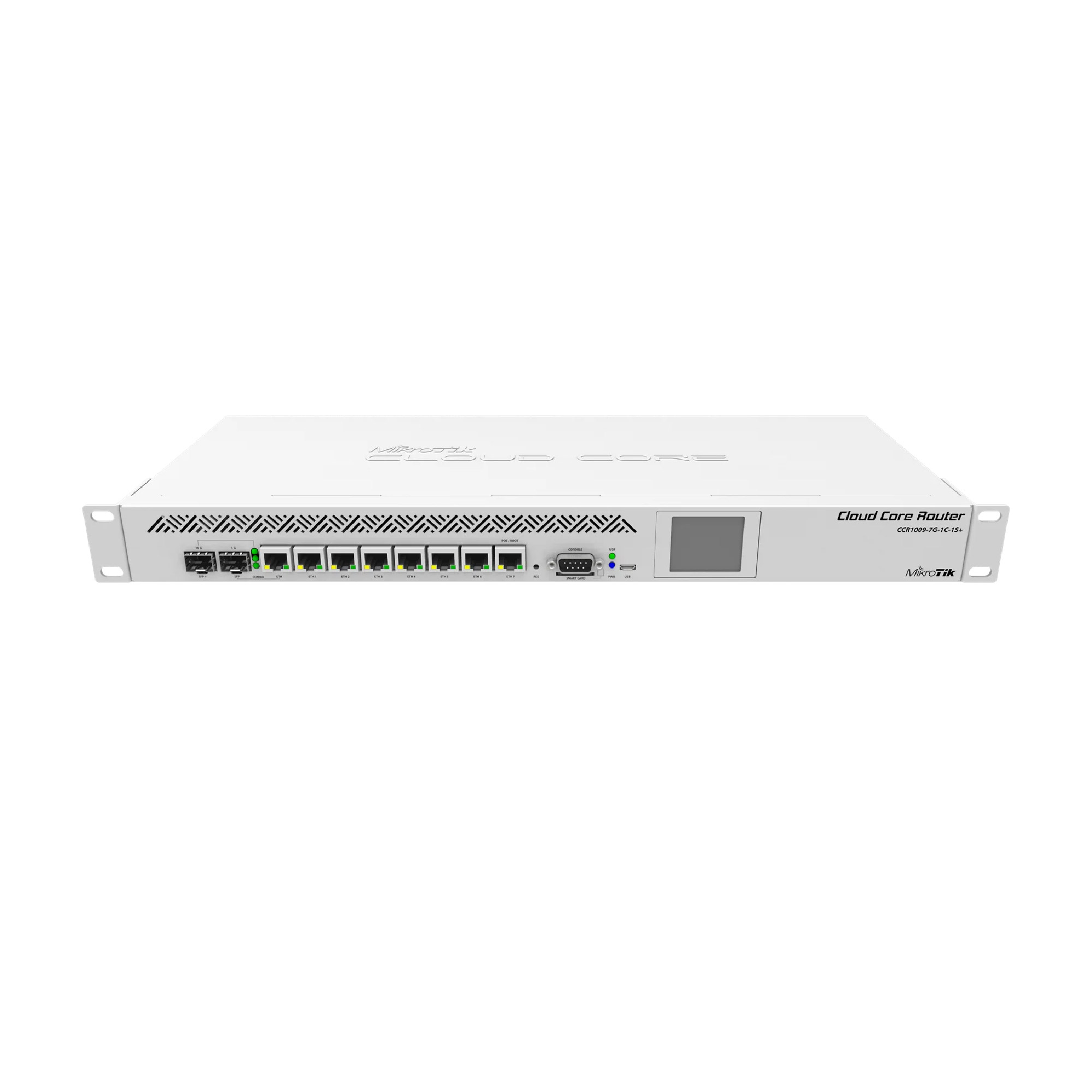
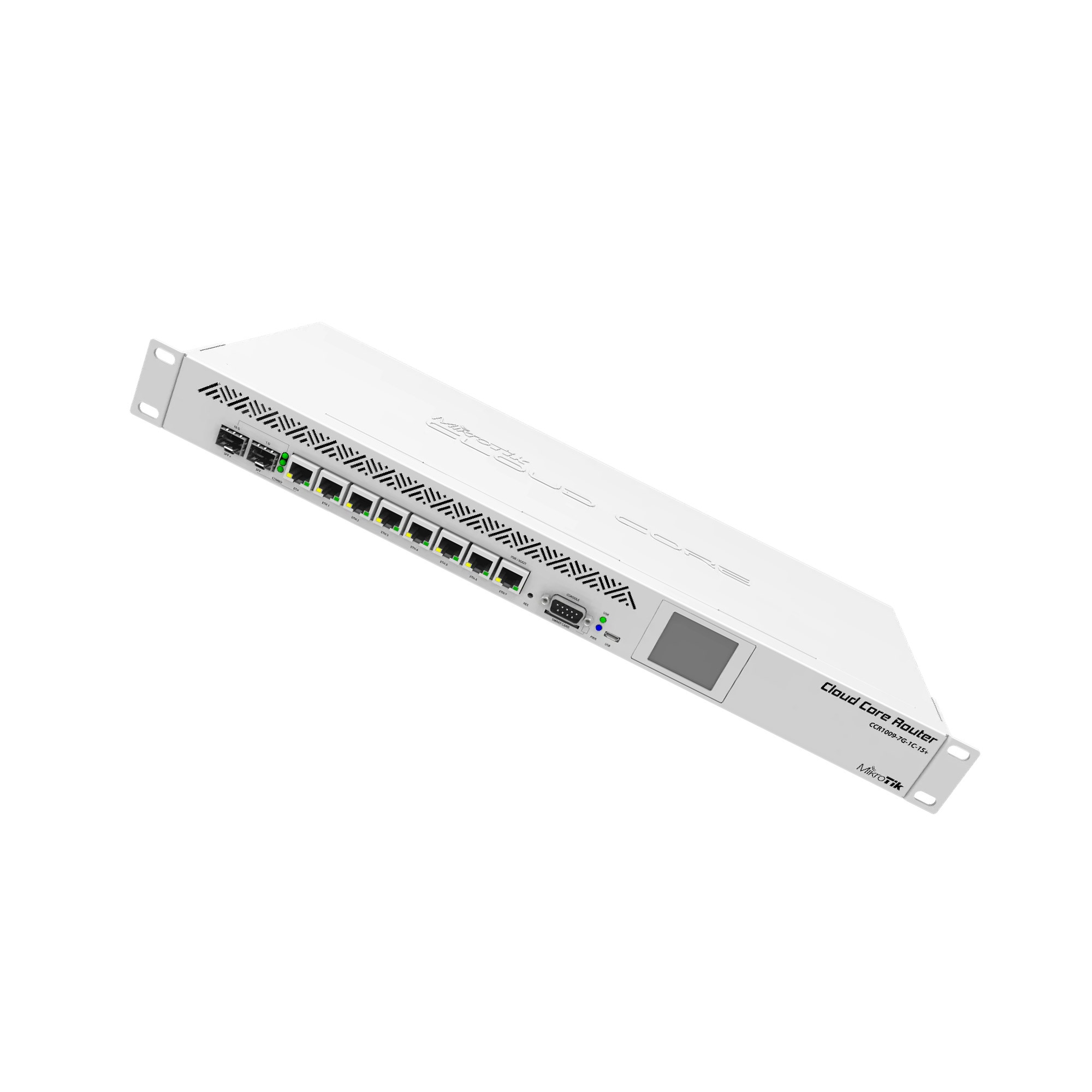

The new updated CCR1009 review is here. We tried to combine all the customer comments and best practices in the manufacture of CCR devices that we learned over the last three years, since the first CCR1009 devices were launched.
Major changes
No switching chip: the device now only has fully independent Ethernet ports, each with a direct connection to the CPU, which allows to overcome the previous 1 Gbit shared limitation of the switching chip ports and use the full potential of the CPU processing power in those ports.
Combined port: a single 1 Gbit software interface that has two hardware interfaces: a SFP box and a Gigabit Ethernet port, allowing you to use any connection available to you. It is also possible to change between the two physical interfaces in RouterOS. In case of disconnection, the combined port provides a hardware error switching function.
Compatibility with 100 Mbps SFP: this is our first device that supports 100BASE-LX / 100BASE-SX / 100BASE-BX fiber modules as well as 1.25 G. standard SFP modules
More performance: Because the ports are now directly connected to the CPU, the new CCR1009 can achieve even greater performance.
Specifications
| Details | |
|---|---|
| Product code | CCR1009-7G-1C-1S + |
| Architecture | TEJA |
| UPC | TLR4-00980 |
| CPU core count | 9 |
| Nominal CPU frequency | 1.2 GHz |
| Dimensions | 443 x 175 x 44 mm |
| Licence of the router operating system | 6 |
| Operating system | OS router |
| RAM size | 2 GB |
| Storage size | 128 MB |
| Type of storage | NAND |
| MTBF | Approximately 200 '000 hours at 25C |
| Proven ambient temperature | -20 ° C to 60 ° C |
| IPsec hardware acceleration | Yes |

Valuation
There are no ratings yet.